
Your hairline frames your face: it sets the height of the forehead, balances the eyes and brows, and changes how every haircut sits. When surgeons design a transplanted hairline, they aim for a soft, irregular front edge and a height that suits your age. They also shape the temples and set each hair at the right angle and direction.
This article looks at what the hairline does for your look and what surgeons weigh up when they design one. It also covers the mistakes that make a hairline look fake.
Why does the hairline matter so much to your look?
Think of it the way a tailor thinks of a collar. You rarely notice a good one, but a poor one throws off the whole outfit. The hairline does the same job for the face.
It shapes your look in three main ways:
- Proportion. It marks where the forehead ends, which changes how long or short the face appears.
- Expression. The front edge and temples frame the eyes and brows.
- Style options. A strong, even hairline lets you wear a swept-back cut or a short crop with confidence.
When the hairline recedes, the face can look longer and the forehead more prominent. Many men first notice it under bright lights or in the barber’s mirror.
It also decides which cuts work. A short crop with a textured fringe forgives an uneven line. A slicked-back pompadour or sharp side parting puts the hairline on full display.
What makes a hairline look natural?
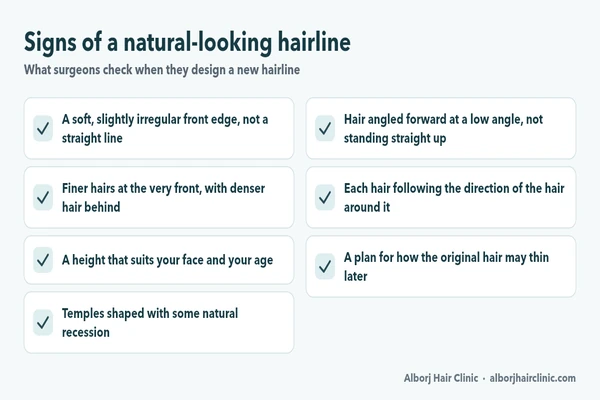
A natural hairline is never ruler-straight. Surgeons focus on four details:
- A soft, irregular front edge. Real hairlines have tiny peaks and gaps, with finer hairs at the very front and denser hair behind.
- The right height. The line sits at a height that suits your face and your age, not the one you had at 18.
- Temples. Most adult men have some recession at the temples, so filling them in completely can look odd.
- Angle and direction. Hair at the front grows forward at a low angle, not straight up, and each graft has to follow suit.
With the DHI technique, each follicle is placed by hand with an implanter pen. That gives the surgeon close control over angle and direction, graft by graft.
Why does a too-low or too-straight hairline look fake?
Because nature rarely draws one. A very low hairline on a man in his forties looks out of step with the rest of his face. A straight, blunt line can look like the edge of a hairpiece, especially up close or with short hair.
There is a long-term reason too. Transplanted follicles usually keep growing once established, yet the hair behind them may still thin with age. A hairline set too low could end up isolated, with a thinner zone behind it.
“The most common request I hear is for the hairline someone had as a teenager. I would rather set a line that suits the face now and still makes sense in twenty years. A hairline placed too low is hard to correct later.”
Does the right hairline change with age?
Yes. Many men’s hairlines move up a little as they mature, even without much hair loss. An adult hairline usually sits slightly higher than a teenage one, with gentle recession at the temples.
That is why surgeons rarely recreate a teenage hairline. The aim is a line that looks right for your age today and will still look right as your face matures.
Age also affects how the donor hair is used. Donor hair at the back and sides is limited, so a careful plan keeps some in reserve in case the original hair thins further.
How do surgeons design a hairline for your face?
Design starts before any surgery. The surgeon studies your face shape, forehead and existing hair. They then draw the proposed hairline on your scalp so you can see it in the mirror.
The stage of hair loss feeds into the plan. Men’s thinning is usually graded on the Norwood scale, which helps the surgeon judge how far it may progress. The amount of healthy donor hair at the back and sides sets how much can be moved.
A good consultation is a conversation, not a sales pitch. Expect the surgeon to explain why they suggest a certain height or shape. It is reasonable to push back and talk it through.
What should you ask about hairline design at a consultation?
Bring questions that focus on the long term, not only the first year:
- How will this hairline look as I get older?
- How will you shape the temples?
- How do you keep the front edge soft?
- What happens if the hair behind the transplant thins later?
- Which hairstyles will this design suit?
A surgeon who designs for the long term should be happy to answer each one in plain words.
Patience is part of the process. The new hairs often fall out in the first few weeks, then regrow from around month three. The finished hairline shows at around 12 months.
About Alborj Hair Clinic
Alborj Hair Clinic is a hair transplant clinic in Mazaya Centre, Al Wasl, Dubai. Its surgeon, Dr Dimitrios Ziakas, has 24 years of experience and has performed more than 4,000 hair transplant procedures. He is a member of the International Society of Hair Restoration Surgery (ISHRS) and uses the DHI (Direct Hair Implantation) technique.
To talk through a hairline design with Dr Ziakas, you can get in touch through Alborj.
The website also features before-and-after case studies that show how designed hairlines look as they grow in.
Frequently asked questions
Should a hairline be perfectly symmetrical?
Not exactly. A natural hairline is broadly balanced, but small irregularities are what make it look real rather than drawn on.
Can a transplanted hairline work with a swept-back style?
Yes, if the design takes that style into account. When the front is on show, the angle and direction of each hair matter even more.
Will the new hairline need special styling?
Once it has grown in, no. You wash, cut and style transplanted hair like the rest of your hair.
Why not just fill the temples completely?
Most adult men have some temple recession, so a fully filled-in front can look unnatural. It can also use donor hair that may be needed later.
